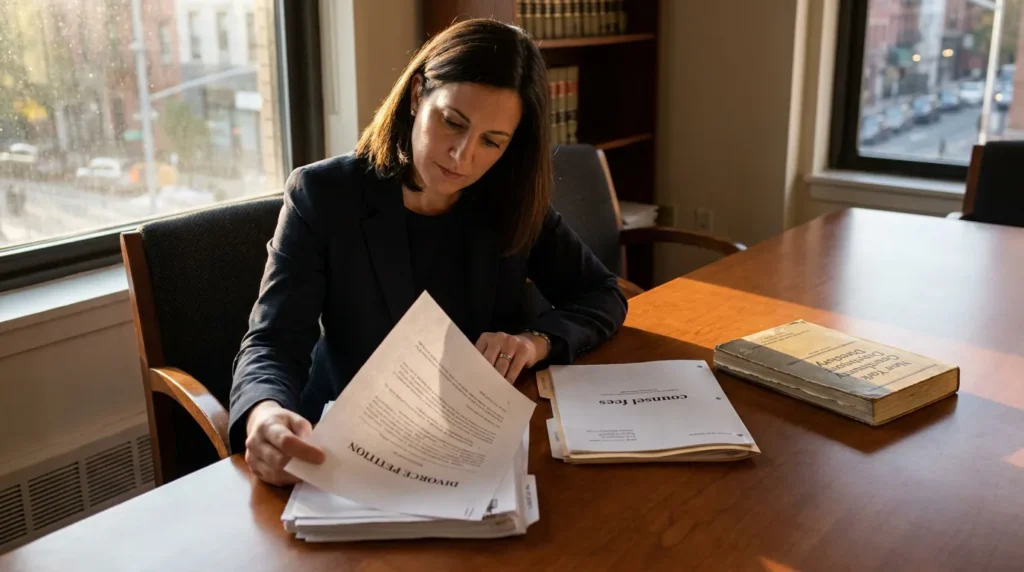
Paying for a Divorce When Your Spouse Controls the Money
Key Takeaways: New York Domestic Relations Law § 237 allows matrimonial courts to order the financially stronger spouse to pay counsel fees and expert fees directly to the other spouse’s attorney in divorce, annulment, and separation actions. The statute creates a rebuttable presumption favoring the less monied spouse, though awards remain discretionary based on each case’s circumstances. Fees should be awarded on a timely, pendente lite basis for adequate representation from the start. Applications may be made anytime before final judgment or afterward on enforcement, annulment, or modification applications. Both parties and attorneys must file affidavits detailing fee arrangements, while unrepresented litigants of limited means may apply with proof of inability to afford counsel. Paying a retainer does not bar a later award, though CPLR 5519 stay provisions can delay receipt of awarded funds.
If you are the spouse with less income, New York law does not expect you to face divorce without a lawyer simply because your spouse controls the finances. Domestic Relations Law § 237 gives matrimonial courts authority to order the financially stronger spouse to pay counsel fees and expert expenses directly to the other spouse’s attorney. The statute creates a rebuttable presumption favoring the less monied spouse, though outcomes depend on each case’s specific facts.
Understanding how fee awards work early can change the entire shape of your case. If you are preparing for divorce in Kings County and worried about funding, the team at Goldberg Sager & Associates can review your circumstances and explain your options. Call 718-645-6677 or reach out to our Brooklyn office to discuss your situation.

What DRL 237 Counsel Fees in New York Actually Cover
The statute authorizes far more than a token contribution toward legal bills. Under New York Domestic Relations Law § 237, a court may direct a spouse or parent to pay counsel fees and expert expenses directly to the attorney of the other spouse or parent. This applies in Supreme Court actions including divorce, annulment, declaring the nullity of a void marriage, and separation. Comparable authority exists for Family Court proceedings under separate provisions of the Family Court Act.
Courts weigh the case circumstances and the parties’ respective financial positions. The amount awarded may be less than sought, subject to the court’s assessment of need, issue complexity, the merits of the parties’ positions, and litigation conduct.
The Rebuttable Presumption Favoring the Less Monied Spouse
DRL § 237 tilts in favor of the financially weaker party. The statute creates a rebuttable presumption that counsel fees shall be awarded to the less monied spouse.
A presumption, however, is not a guarantee. The monied spouse may rebut it by showing, for example, that the other party has independent access to liquid assets or that requested fees are disproportionate to the issues in dispute. Courts may also consider whether a party’s conduct unnecessarily prolonged the case. Because the analysis is fact-dependent, two Brooklyn cases with similar incomes can produce different results.
Why Timing Matters More Than Most People Expect
Fee awards under the statute are meant to arrive early, not at the end of the case. DRL § 237 directs that courts shall seek to assure that each party is adequately represented and that fees, when awarded, shall be awarded on a timely basis, pendente lite, so as to enable adequate representation from the commencement of the proceeding. Applications may be made at any time prior to final judgment, though interim awards may be reallocated or adjusted at trial.
Waiting until trial to raise the fee issue can leave a party under-resourced during discovery and negotiation. In practice, a pendente lite application is often filed alongside or shortly after early motion practice. Understanding when to hire a divorce lawyer is closely tied to this timing.
💡 Pro Tip: Gather your most recent tax returns, W-2s, pay stubs, and account statements before your first consultation. A well-documented net worth statement is often the backbone of a persuasive interim fee application.
Post-Judgment and Enforcement Fee Awards
Section 237 does not stop when the judgment is signed. Fee awards may also be available upon applications to enforce, annul, or modify orders or judgments concerning maintenance, distributive awards, marital property distribution, custody, or visitation. Under DRL § 237(c), the statute makes a fee award mandatory in certain enforcement proceedings where a court finds that a party willfully failed to obey a lawful order compelling payment of support, maintenance, or a distributive award.
These post-judgment applications are evaluated on their own record. Courts may consider the underlying application’s merits, the parties’ current financial positions, and whether the litigation was reasonably necessary.
What You and Your Attorney Must File
The statute imposes a disclosure requirement on both sides. Both parties and their respective attorneys must file an affidavit with the court detailing the financial agreement between the party and the attorney. This transparency requirement is central to matrimonial attorney fees in NY.
The affidavit generally must include:
- The amount of any retainer, and amounts paid and still owing
- The attorney’s hourly rate
- Amounts paid or to be paid to experts
- Any additional costs, disbursements, or expenses
Self-represented litigants of limited means are not shut out. An unrepresented party may apply without the fee-arrangement affidavit upon submitting proof of inability to afford counsel, including a net worth statement and, where available, W-2 statements and tax returns.
Standing and Retainers
Two features often surprise clients. First, applications for fees and expenses may be maintained by the attorney for either spouse in counsel’s own name in the same proceeding. Second, payment of a retainer fee does not preclude an award of fees and expenses that would otherwise be allowable.
Scraping together an initial retainer does not necessarily forfeit a later request. Many Brooklyn litigants borrow from family to fund the first phase and then seek reimbursement or forward-looking fees. Whether that succeeds depends on the record presented to the court.
The Stay Problem: When an Award Does Not Mean Payment
Winning a fee award and receiving the money are not the same thing. As practitioners have detailed in analysis published by the New York State Bar Association, CPLR 5519(a)(2) permits a party ordered to pay money to obtain an automatic stay by posting an undertaking pending appeal. The result can be a delay in the funds the non-monied spouse needs to litigate. An appellate court may vacate or modify such a stay under CPLR 5519(c).
A parallel provision applies to installment payments. Where an order directs payment of money in fixed installments, a stay may be awarded upon posting an undertaking in a sum set by the court under CPLR 5519(a)(3).
| Provision | What It Does | Practical Effect |
|---|---|---|
| DRL § 237(a)-(b) | Authorizes interim and post-judgment fee awards to the less monied spouse | Aims to level the economic playing field |
| CPLR 5519(a)(2) | Automatic stay on posting an undertaking pending appeal | May delay receipt of awarded fees |
| CPLR 5519(a)(3) | Stay on installment orders upon a court-set undertaking | May postpone scheduled fee payments |
Commentators have argued that this interplay causes prejudice to non-monied spouses. The NYSBA analysis describes the statutes as being in tension with one another. Until legislative change occurs, this remains a potential litigation risk that counsel should discuss candidly with clients.
💡 Pro Tip: Ask your attorney early whether your fee award might realistically be appealed. Understanding that possibility can shape how you budget and sequence discovery.
Practical Challenges Brooklyn Litigants Face
The most common obstacle is proving the income disparity. When a spouse is self-employed, holds an interest in a closely held business, or receives significant non-salary compensation, establishing the true financial picture may require forensic accounting. Those costs may themselves be recoverable as expert fees under the statute.
Documentation discipline separates strong applications from weak ones. Courts reviewing a counsel fee award request in Brooklyn generally want a clear net worth statement, supporting financial records, and a coherent explanation of the work anticipated. Working with an experienced Brooklyn divorce attorney can help ensure the application is properly supported.
Remember that fee litigation is only one piece of the case. Equitable distribution, maintenance, custody, and support each have their own standards.
Frequently Asked Questions
1. Does the court always order the wealthier spouse to pay all my legal fees?
No. DRL § 237 creates a rebuttable presumption favoring the less monied spouse, but the award remains discretionary. Courts frequently award a portion of the fees requested rather than the full amount.
2. Can I ask for fees if I have already paid a retainer?
Generally, yes. The statute provides that payment of a retainer fee does not preclude an award of fees and expenses that would otherwise be allowable.
3. When should I file a fee application in a Brooklyn divorce?
The statute contemplates timely, pendente lite awards so a party can be adequately represented from the commencement of the proceeding. Many litigants raise the issue early, though the right timing depends on your case’s posture.
4. What if my spouse appeals the fee order?
Under CPLR 5519(a)(2), a party ordered to pay money may obtain an automatic stay by posting an undertaking pending appeal, which can delay your receipt of the funds. An appellate court has authority to vacate or modify that stay.
5. Can I apply if I do not currently have a lawyer?
Possibly. An unrepresented party of limited means may apply without the fee-arrangement affidavit upon submitting proof of inability to afford counsel, including a net worth statement and, where available, W-2s and tax returns.
Moving Forward With Confidence
Domestic Relations Law 237 is intended to ensure that a divorce is decided on the merits rather than on who can outspend whom. The statute authorizes interim and post-judgment awards, presumes the less monied spouse should receive fees, and requires transparency from both parties and their attorneys. At the same time, procedural stay provisions and the discretionary nature of the award mean results vary.
If you are facing divorce in Brooklyn and are concerned about funding your representation, do not wait to get answers. The attorneys at Goldberg Sager & Associates have extensive experience handling matrimonial matters throughout Kings County. Call 718-645-6677 or schedule a consultation today to discuss how DRL 237 counsel fees in New York may apply to your circumstances.
Disclaimer: This content is for informational purposes only and is not legal advice. Every case is unique, and results may vary. Consult an attorney about your specific circumstances.