Understanding Who Pays After a Parking Lot Slip and Fall in New York
Key Takeaways: Liability for a New York parking lot slip and fall depends on who owned, controlled, or maintained the property. Responsibility may fall on a property owner, tenant business, management company, or municipality, often more than one party simultaneously. Under New York premises liability law, an owner generally cannot avoid responsibility by delegating maintenance to another party. To prevail, you must establish duty, breach, causation, and damages, including that the responsible party created or had notice of the hazard. New York’s pure comparative negligence rule under CPLR § 1411 reduces recovery by your share of fault but does not bar it, and defendants must prove your fault. Deadlines vary sharply: most private claims allow three years under CPLR § 214, while municipal claims require a Notice of Claim with far shorter windows.
A slip and fall in a New York parking lot can leave multiple parties potentially responsible. Identifying who is liable depends on who owned, controlled, or maintained the property. Liability may fall on the property owner, a tenant business, a management company, or even a municipality. New York premises liability law requires the person controlling the property to keep it reasonably safe, and when they fail to do so, an injured visitor may have a valid claim.
If you were hurt in a parking lot fall, the team at Goldberg Sager & Associates offers free consultations to help evaluate liability. Call our office at 718-645-6677 or reach us through our confidential case review form.
Establishing Duty, Breach, and Causation in a New York Parking Lot Fall
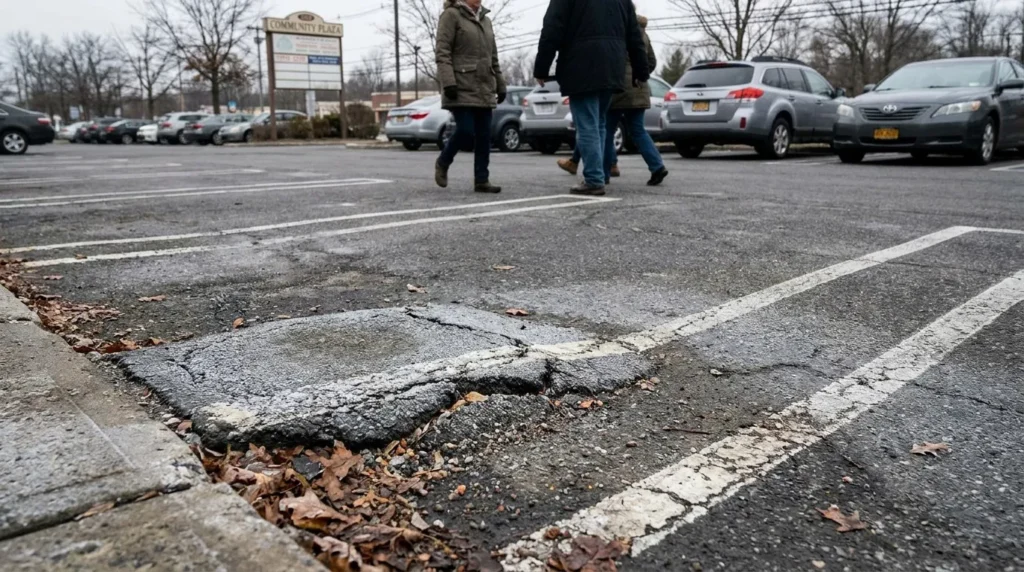
Every premises liability case in New York begins with the duty of care owed by the party controlling the property. A property owner or occupier generally owes visitors a duty to maintain the premises in a reasonably safe condition and to address known hazards or hazards discoverable through reasonable inspection. In parking lot slip and fall cases, this duty covers icy surfaces, potholes, broken pavement, poor lighting, and unmarked elevation changes.
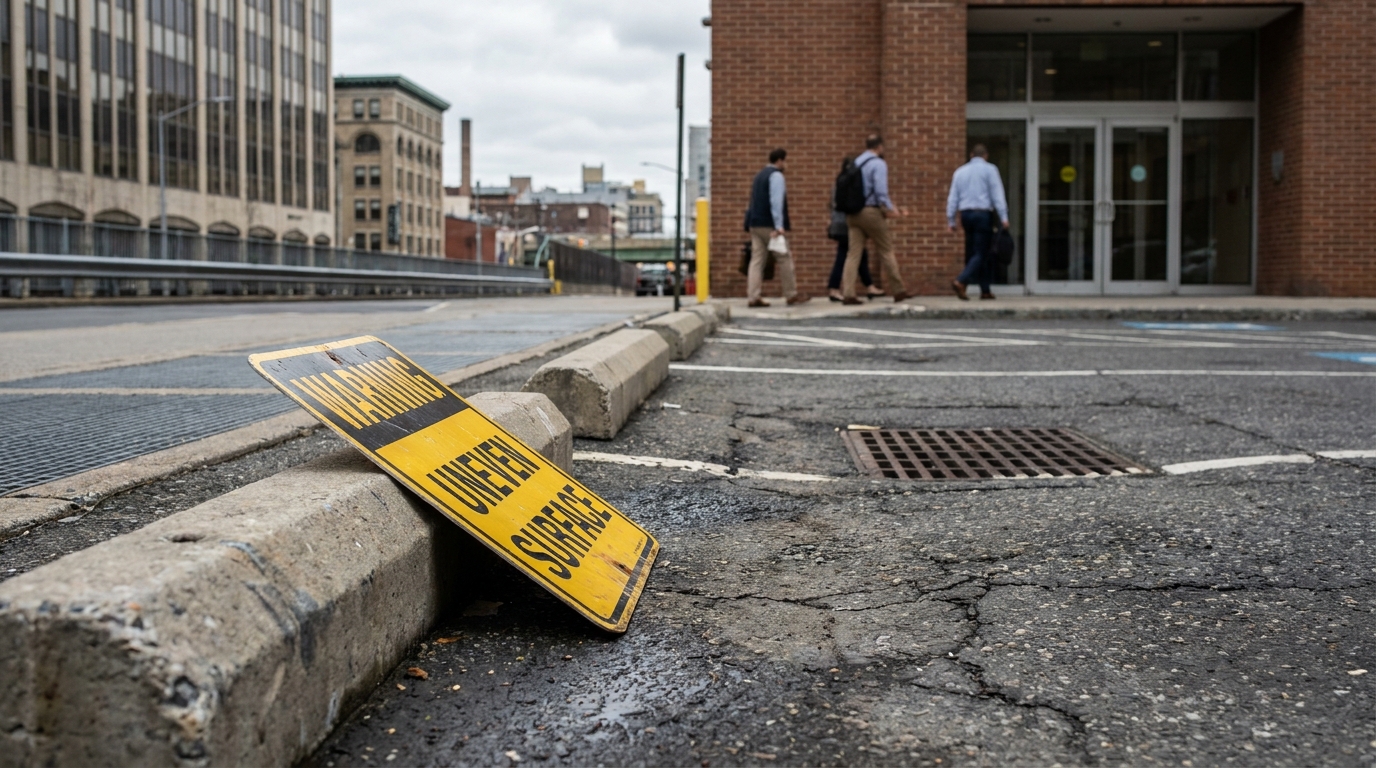
Proving liability requires more than showing a fall occurred. An injured person must establish four elements: the responsible party owed a duty, they breached it by allowing a hazard to exist, the hazard caused the injury, and measurable damages resulted. Courts consider whether the owner created the condition or had actual or constructive notice, meaning the hazard existed long enough that it should have been found and fixed.
💡 Pro Tip: Photograph the hazard, your injuries, and the surrounding area immediately, and collect witness names. Evidence can disappear quickly, and prompt documentation strengthens your claim.
How Multiple Parties Can Share Responsibility
More than one party may be liable for a single parking lot fall in New York. Ownership and control are not always held by the same person. A landowner who leases space to a retailer, a property management firm, and the underlying owner can each play a role in maintenance, and liability follows control over the dangerous condition.
Hiring an administrator or management company does not automatically shield the underlying owner. Under New York law, an owner can remain liable even when a third party manages the property. This principle is reflected in Real Property Actions and Proceedings Law § 778(6), which states that appointing an administrator does not relieve an owner of liability for injury. While that provision arises in a specific statutory context involving court-appointed administrators, it illustrates a broader premises liability principle: under New York common law, an owner generally cannot escape responsibility by delegating maintenance. For parking lot slip and fall liability, this means an injured visitor may have multiple potential defendants.
💡 Pro Tip: Keep receipts, parking tickets, or photos showing which business or lot you visited. Identifying the correct owner or operator early helps avoid naming the wrong party.
Comparative Fault and Slip and Fall Parking Lot Settlements
New York follows a pure comparative negligence rule, which directly affects slip and fall parking lot settlements. Under this system, an injured person’s own carelessness does not bar recovery. Instead, damages are reduced in proportion to the claimant’s share of fault. New York’s comparative negligence framework under Article 14-A governs how contributory negligence affects recovery.
Under CPLR § 1411, culpable conduct attributable to the claimant does not eliminate a claim. Damages are diminished in proportion to the claimant’s share of fault. Because the rule is "pure," a plaintiff found largely responsible could still recover a reduced amount. For example, a victim found 30% at fault on a $100,000 award would recover $70,000.
Comparative fault is a defense the other side must prove. Under CPLR § 1412, culpable conduct claimed to reduce damages is an affirmative defense that the asserting party must plead and prove. The chart below summarizes how these principles interact.
| Issue | General New York Rule | Statute |
|---|---|---|
| Effect of your own fault | Reduces, does not bar, recovery | CPLR § 1411 |
| Who proves your fault | The defendant must plead and prove it | CPLR § 1412 |
| How comparative fault is applied to a judgment | Comparative fault reduces the award under § 1411; CPLR § 5041 is a structured-judgment provision that instructs courts to apply § 1411 (along with other rules) when calculating judgment amounts. | CPLR § 5041 |
Deadlines That Can Make or Break a Parking Lot Injury Claim
The time limit for filing a New York slip and fall case depends on who owns the parking lot. For most private property claims, the statute of limitations under CPLR § 214 is three years from the accident date. Missing this window can permanently bar an otherwise valid case.
A discovery rule applies only in narrow circumstances. New York does not recognize a general discovery rule for ordinary slip and fall claims, which typically accrue on the injury date. Under CPLR § 203(g), the clock runs from discovery only where a statute expressly makes discovery part of when the claim accrues. Because courts interpret these exceptions narrowly, assume the standard accrual date applies.
Claims against municipal entities follow much stricter procedures. Common requirements include:
- A Notice of Claim generally must be served on the municipality under General Municipal Law § 50-e before any lawsuit
- Lawsuits generally must begin within one year and 90 days of the accident
- For villages, CPLR § 9801 requires a Notice of Claim, and CPLR § 9802 requires suit within one year of accrual
- For New York City claims, a Notice of Claim is filed with the Comptroller before suit
💡 Pro Tip: If your fall happened in a municipally-owned lot, treat the deadline as urgent. Shortened municipal timeframes can expire long before the standard three-year period.
What Injured Visitors Should Do to Protect a Claim
Taking organized steps after a fall preserves both your health and legal options. Seeking medical attention promptly creates a record linking the hazard to your injuries, supporting the causation element. Reporting the incident to the property owner, store, or manager creates documentation of when and where the fall occurred.
Researching your rights is a sensible early move. Reviewing a firm’s premises liability resource articles helps you understand common challenges, such as proving notice or identifying the correct defendant.
💡 Pro Tip: Save the shoes and clothing you wore during the fall exactly as they were. This physical evidence can rebut arguments about improper footwear or assumption of risk.
Frequently Asked Questions
1. Who is usually liable for a parking lot slip and fall in New York?
Liability generally rests with the party that owned, controlled, or maintained the lot. This can include a property owner, tenant business, or management company. Because an owner generally cannot avoid liability by delegating maintenance, multiple parties may share responsibility.
2. Can I still recover if I was partly at fault?
Yes. New York’s pure comparative negligence rule under CPLR § 1411 reduces damages by your percentage of fault rather than eliminating recovery. The defendant must prove your share of fault under CPLR § 1412.
3. How long do I have to file a slip and fall claim?
For most private property claims, the deadline is three years from the accident under CPLR § 214. Municipal claims often involve a Notice of Claim and shorter windows. Confirm your specific deadline promptly.
4. What is a Notice of Claim, and when is it required?
A Notice of Claim is formal notification served before suing a government entity. Under General Municipal Law § 50-e and provisions like CPLR § 9801, it is generally required for claims against municipalities. Missing it can bar your case entirely.
5. What affects the value of slip and fall parking lot settlements?
Settlement value depends on liability strength, injury severity, medical costs, and your comparative fault percentage. Strong evidence of notice and causation supports stronger outcomes.
Protecting Your Rights After a New York Parking Lot Fall
A slip and fall in a New York parking lot can involve multiple potentially responsible parties, a fault-allocation system that reduces but does not erase recovery, and deadlines that vary sharply between private and municipal property. Understanding duty, breach, causation, and the comparative negligence rules under Article 14-A gives injured visitors a clearer view of how property owner liability in New York works. Because these claims are fact-sensitive and time-limited, acting quickly to preserve evidence and confirm the correct deadline is essential.
If you or a loved one was injured in a New York parking lot fall, the attorneys at Goldberg Sager & Associates are ready to review your situation during a free consultation. Call us now at 718-645-6677 or send your details through our secure contact page so we can help you understand your options and protect your rights before important deadlines pass.