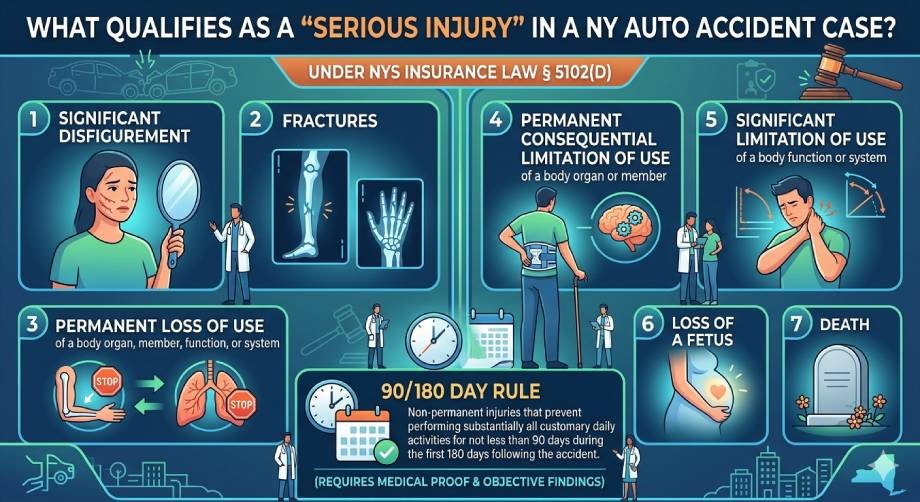
Car accident-related injuries can be debilitating and costly. However, New York is a no-fault insurance state, which means that your right to sue another driver for damages is limited. You must establish that you incurred economic losses exceeding your no-fault coverage or that you sustained a serious injury. The term “serious injury” is not subjective. State law defines the types of injuries that meet the definition.
Under the New York Insurance Law, serious injuries are those that result in:
- Death
- Dismemberment
- Significant disfigurement
- Fracture
- Loss of a fetus
- Permanent loss of use of a body organ, member, function or system
- Permanent consequential limitation of a body organ or member
- Significant limitation of use of a body function or system
New York law previously recognized a ninth serious injury category, commonly called the “90/180-day rule”, which allowed claims based on a medically determined, non-permanent injury that prevented a person from performing substantially all of their usual and customary daily activities for at least 90 of the first 180 days following an accident. As part of New York’s 2026 motor vehicle tort reform legislation, this category was eliminated for actions commenced after May 26, 2026, meaning it can no longer be used to satisfy the serious injury threshold. Injured individuals who do not have a fracture or permanent condition must now establish their claim under one of the eight remaining statutory categories, such as permanent consequential limitation or significant limitation of use of a body function or system. If you are unsure which category applies to your injuries, speaking with a personal injury attorney is an important first step.
While certain types of serious injuries can be directly diagnosed, those relating to physical impairments and limitations can be difficult to prove. For example, “permanent loss or use” is interpreted by the courts as a total loss only. “Permanent consequential limitation” requires objective medical evidence demonstrating your reduced range of motion or comparing your limitations with how the affected body part would have functioned had you not been injured.
Proving a serious injury can also be difficult if you had a pre-existing medical condition before the auto accident occurred. In such a case, the medical evidence must clearly demonstrate that your injuries resulted from the accident. A doctor must provide an explanation of the medical evidence he or she relied upon to reach the conclusion that the accident — not a previous event or occurrence — caused your injuries. If you were not treated continuously after the accident, you must provide evidence that there was a medical reason that treatment was stopped.
If you’ve been badly injured in an auto accident, you need an experienced personal injury attorney on your side who can help you obtain the maximum compensation you deserve. Goldberg Sager & Associates is committed to securing favorable outcomes for auto accident victims. Call 718-645-6677 or contact us online to schedule a consultation at our Brooklyn office.