Your Crash Reporting Duties Under New York Law
Key Takeaways: The MV-104 is the New York DMV form drivers use to meet the crash reporting duty in N.Y. Veh. & Traf. Law § 605. Drivers must file it within ten days of a crash that causes injury, death, or property damage over $1,000 to any one person’s property. A police report does not meet this duty, so file your own report even if officers came to the scene. If the driver is physically unable to file, another person in the vehicle who is able to may have to file it. A hit-and-run with an unidentified vehicle generally must be reported within 24 hours to support an MVAIC claim. Filing an accurate, factual report on time helps protect your license, your insurance, and any injury claim, but it does not start a lawsuit or preserve your right to sue.
The MV-104 is the New York Department of Motor Vehicles (DMV) form that drivers use to meet their crash reporting duty under the New York Vehicle and Traffic Law. Under N.Y. Veh. & Traf. Law § 605, a driver in a crash that causes injury, death, or property damage over $1,000 to any one person’s property must file a written report with the Commissioner of Motor Vehicles within ten days. Many drivers assume the police report covers this duty. It does not. If you were hurt in a crash in Brooklyn or anywhere else in New York City, knowing when and how to file this report can protect your license and support any injury claim you bring later.
If you have questions about your crash report or your injury claim, Goldberg Sager & Associates can help you understand your options. Call 718-645-6677 or contact us now to talk about your situation.
MV-104 Explained: The Law Behind the Form
The MV-104 report of motor vehicle crash is an administrative filing, and a statute gives it legal force. Article 22 of the New York Vehicle and Traffic Law, titled "Accidents and Accident Reports," sets out the rules for reporting crashes. The reporting duty itself appears in N.Y. Veh. & Traf. Law § 605. Other New York statutes refer to a "motor vehicle accident report pursuant to section six hundred five of the vehicle and traffic law," which confirms that Section 605 is the source of the driver’s duty.
The form is how you comply, and the statute is the rule you must follow. The DMV’s MV-104 instructions are agency guidance based on the statute, and they do not override it. For this reason, careful drivers read both the form instructions and the statute.
How Section 600 Connects to the Reporting Duty
Your reporting duties begin at the scene. N.Y. Veh. & Traf. Law § 600 requires a driver who knows or has cause to know that a crash caused property damage, personal injury, or death to stop and show their license and insurance information. If the crash caused only property damage and the owner is not present, the driver must report it to police as soon as physically able. If someone was hurt or killed, the driver must also report the crash to police as soon as physically able. The written MV-104 report is a separate duty that comes after these duties at the scene. Together, these two laws form the core of New York car accident reporting.
When to File MV-104: Deadlines and Triggers for the MV 104 Form New York Drivers Use
You must file within ten days of the crash if it caused injury, death, or property damage over $1,000 to any one person’s property. The text of VTL Section 605 reporting requires the report to go to the Commissioner "within ten days." The ten days start on the date of the crash, not the date you see a doctor or speak with an insurer.
| Crash Outcome | Is an MV-104 Generally Required? | Deadline |
|---|---|---|
| Any personal injury | Yes | Within 10 days |
| Death | Yes | Within 10 days |
| Property damage over $1,000 to any one person | Yes | Within 10 days |
| Property damage of $1,000 or less, no injury | Generally not required | N/A |
Why the Police Report Does Not Replace Your Filing
A police report is separate from your own DMV crash report in New York. Police at the scene may file their own report, but you still have your Section 605 duty. Many injured people learn this only after they get a DMV notice. Filing your own report on time removes this risk.
💡 Pro Tip: Keep a dated copy of your completed MV-104 and any proof that you mailed or submitted it. If anyone questions your filing, this record can show you met the deadline.
Reporting When You Are Injured
Serious injuries can make it hard to file on time, and the statute addresses this. Under N.Y. Veh. & Traf. Law § 605, if the driver is physically unable to report and another person in the vehicle is able to, that person must make the report or have it made. Whether a court excuses a delay depends on the facts, so it is safer to have a family member or attorney help you file promptly than to rely on this rule.
MV-104 Filing Requirements: What the New York Crash Report Form Asks For
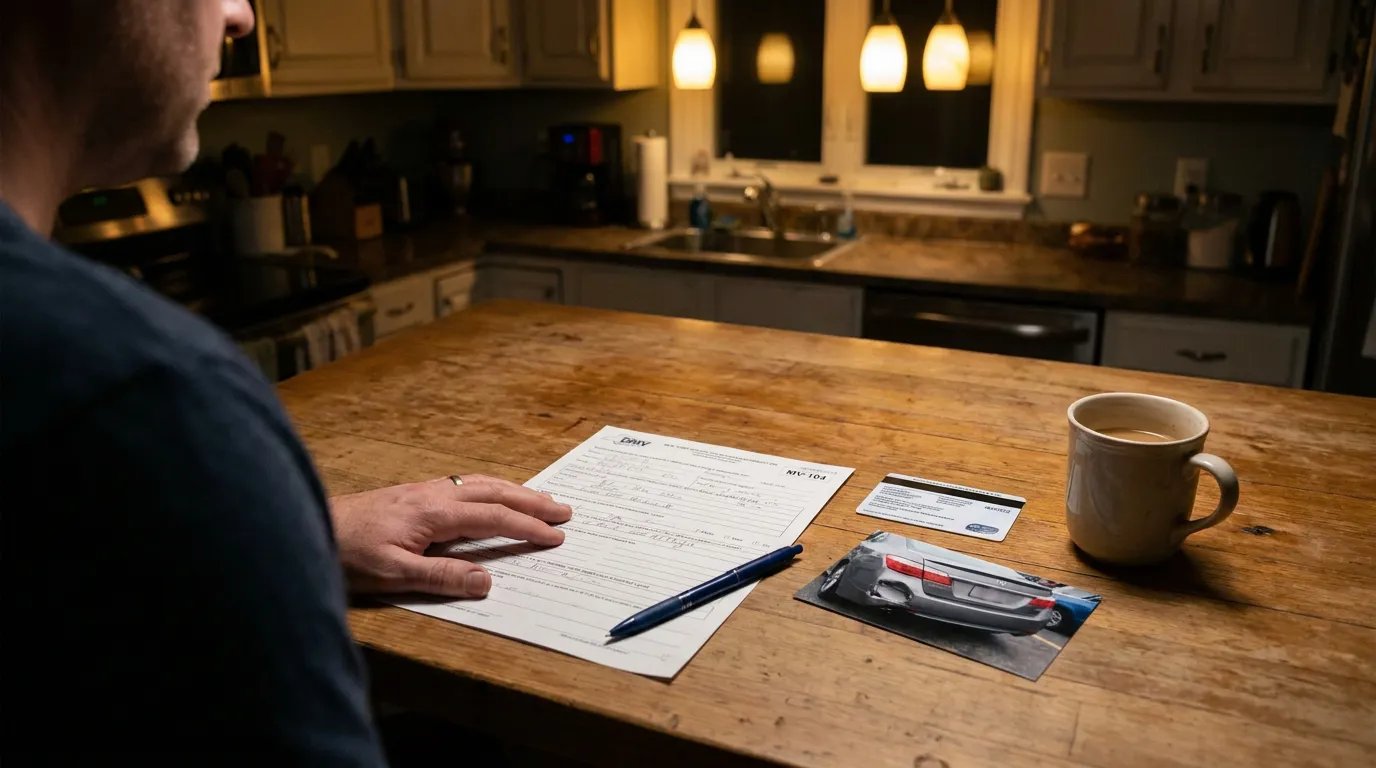
The form asks for detailed facts about the crash, the vehicles, and the people involved. Accuracy matters because insurers and opposing lawyers may compare your report with what you say later. Before you start, gather:
- Your driver’s license, registration, and insurance card information
- The other driver’s name, license, plate number, and insurer, which you exchanged under VTL § 600
- The date, time, and exact location of the crash
- A short, factual description and diagram of how the crash happened
- Names of injured people and witnesses
- An estimate of property damage
Stick to facts you know. Do not guess about speed or fault, and do not downplay your injuries. Pain from whiplash or a concussion often gets worse days later, so calling yourself "uninjured" too early may hurt your claim.
How Reporting Affects Your Injury Claim
A prompt, accurate report can help keep your claim strong. Insurance companies may look for inconsistencies to deny or reduce claims. A timely MV-104 that matches your medical records and witness accounts helps create a consistent paper trail. For a broader checklist of steps after a crash, our guide to New York car accident reporting covers what to do in the first days.
Hit-and-Run Crashes Have Stricter Rules
If the at-fault driver fled and cannot be identified, a 24-hour reporting rule generally applies. Under the Motor Vehicle Accident Indemnification Corporation (MVAIC) rules in N.Y. Ins. Law § 5208, a claim involving an unidentified vehicle generally requires that you report the crash within 24 hours to a police, peace, or judicial officer or to the Commissioner of Motor Vehicles. Section 5208 also sets a separate deadline for filing a notice of claim with MVAIC, generally within 90 days. A late report may be excused if reporting within 24 hours was not reasonably possible and you reported the crash as soon as you reasonably could. Courts apply that exception based on the facts, so report a hit-and-run right away instead of counting on it.
💡 Pro Tip: In a hit-and-run, call the police from the scene if you safely can. A 911 call record can help show you met the 24-hour rule.
Risks of Skipping or Delaying Your DMV Crash Report in New York
Failing to report can affect your license and your insurance. Under VTL § 605, the DMV may suspend a driver’s license or registration until the driver files a required report. Separately, under N.Y. Ins. Law § 3425, a conviction for leaving the scene of an incident without reporting is one of the listed convictions, along with offenses such as DWI and reckless driving, that may let an insurer cancel or refuse to renew an auto policy.
Reporting deadlines are separate from deadlines for lawsuits. Filing an MV-104 does not start a lawsuit or preserve your right to sue. The time limits for a personal injury lawsuit in New York, and any narrow exceptions to them, are separate rules. Courts often read exceptions narrowly, so get legal advice early. An experienced MV 104 form New York lawyer can explain which deadlines apply to your case.
Frequently Asked Questions
1. Do I need to file the MV-104 form in New York if the police came to the scene?
Yes, if the crash meets the reporting threshold. The duty under N.Y. Veh. & Traf. Law § 605 belongs to the driver, and a police report does not meet it.
2. What is the deadline to file the MV-104 report of motor vehicle crash?
Under VTL § 605, the report is due within ten days of the crash when there was injury, death, or property damage over $1,000 to any one person’s property.
3. Can someone else file the report if I am in the hospital?
Yes. If the driver is physically unable to report, another person in the vehicle who is able to must make the report. A family member or attorney can also help you file. The facts of your case determine how a delay is treated.
4. Does filing an MV-104 mean I am admitting fault?
No. The report records facts about the crash. Still, insurers and the other side may review it, so stick to accurate facts and avoid statements about fault.
5. Is a hit-and-run reported differently?
Yes. If the other vehicle cannot be identified, a claim through MVAIC under N.Y. Ins. Law § 5208 generally requires a report within 24 hours and a notice of claim to MVAIC, generally within 90 days. These rules apply in addition to your MV-104 duty.
Protecting Yourself After You File
The MV-104 form New York law requires is short, but it can affect your license, your insurance, and your injury claim. File within ten days when VTL § 605 applies, report hit-and-runs within 24 hours, and keep your statements factual and consistent. Every case depends on its own facts, so getting advice early can help you avoid mistakes that insurers might use against you.
If you were hurt in a New York crash, Goldberg Sager & Associates is ready to review your situation. Call 718-645-6677 or reach out today to learn about your next steps.
Disclaimer: This content is for informational purposes only and is not legal advice. Every case is unique, and results may vary. Consult an attorney about your specific circumstances.