Proving Family Ties When an Estate Has No Obvious Heirs
Key Takeaways: A kinship hearing is a formal evidentiary proceeding in New York Surrogate’s Court where individuals claiming to be relatives of someone who died without a will generally must prove their family relationship before receiving any share of the estate. The court applies EPTL Article 4 to determine the order in which relatives inherit, while the SCPA, including § 2225, found in Article 22 (Accounting), supplies much of the procedural and evidentiary framework. Claimants typically rely on certified vital records, immigration and census documents, genealogical charts, disinterested witness testimony, and sometimes DNA evidence. Because a closer relative generally excludes more distant ones, claimants must often prove both their own relationship and that no nearer heir exists. Missing or foreign records are among the most common obstacles, and many kinship trials are heard by a referee whose report the Surrogate may confirm, modify, or reject. If no distributees are ever established, funds are generally deposited with the State Comptroller and may eventually escheat to the State of New York, subject to later claim.
When someone dies in New York without a will and without clearly identified relatives, the Surrogate’s Court generally cannot simply hand over the estate to whoever steps forward. Instead, the court may hold a kinship hearing: a formal evidentiary proceeding in which people claiming to be relatives are generally expected to prove their family relationship to the decedent. The court typically examines documentary records, genealogical charts, and testimony before deciding who qualifies as a distributee under New York’s intestacy statutes. Until that proof is accepted, the assets generally remain under court supervision.
If your family is facing an estate where heirship is unclear, the probate and Surrogate’s Court litigation attorneys at Goldberg Sager & Associates can help you understand what the court may expect. Call 718-645-6677 or contact us now to discuss your situation with a Brooklyn attorney who handles these matters regularly.
Why New York Requires Formal Proof of Heirship
New York generally treats heirship as something that must be established, not assumed. When a person dies without a will, property generally passes to the decedent’s distributees under intestacy rules rather than to anyone named in a document. The court’s role is generally to confirm, through admissible evidence, who those distributees are before any distribution occurs.
This requirement exists because estate assets may be difficult to recover once released. A Surrogate who accepts unverified claims risks paying an estate to someone with no legal entitlement while an actual heir remains unlocated. The statutory framework builds in safeguards, including notice requirements and evidentiary thresholds a claimant generally must satisfy.
The Surrogate’s Court Procedure Act supplies most of the procedural machinery. It governs practice in Surrogate’s Courts statewide, including proceedings involving the identification of distributees. SCPA Article 22, "Accounting," governs judicial settlement of fiduciary accounts and distribution of estate funds, and SCPA § 2225 allows the court, after a diligent and exhaustive search, to determine that no other distributees exist or that persons are deceased. Related provisions, such as SCPA § 2222, direct that a distributive share payable to an unknown person be paid to the State Comptroller.
The Statutory Hierarchy Behind Every Kinship Determination
Estates, Powers and Trusts Law Article 4 sets out the order in which relatives may inherit. EPTL § 4-1.1, "Descent and distribution of a decedent’s estate," establishes priority among a surviving spouse, children, parents, siblings, grandparents, and more remote relations. The New York intestacy statute is generally the framework the court applies when deciding who may share in an estate. That statute cuts off inheritance beyond the great-grandchildren of the decedent’s grandparents, and no relative more remote than a first cousin once removed may take, first cousins once removed (great-grandchildren of grandparents) are themselves the most remote class recognized under EPTL § 4-1.1(a)(7).
Degree of relationship can matter enormously. EPTL § 4-1.2 addresses inheritance rights of non-marital children, and other provisions of Article 4 govern how degrees of kinship are computed and how representation works. Referees may use these rules to determine whether a claimant falls within the class of eligible distributees or whether a closer relative cuts off the claim entirely.
A closer relative generally excludes more distant ones. If a decedent left a child, cousins generally have no claim. This is why a kinship proceeding often involves proving both who the claimant is and that no nearer relative exists, a negative that can be difficult to establish.
| Relationship Category | General Position Under EPTL § 4-1.1 | Typical Proof Burden |
|---|---|---|
| Spouse and children | Highest priority | Usually straightforward vital records |
| Parents | Generally inherit when no spouse or issue | Moderate documentary proof |
| Siblings and their issue | Generally inherit when no spouse, issue, or parents survive | Often requires genealogical work |
| Grandparents’ descendants (first cousins once removed, etc.) | Most remote class recognized; nothing passes beyond first cousins once removed | Extensive records and testimony commonly needed |
What Happens During a Kinship Hearing Surrogate’s Court New York Families Should Expect
The proceeding generally begins after an administrator is appointed or a public administrator takes control of the estate. Letters of administration are generally issued to an eligible distributee in the order of priority set by SCPA § 1001, and where no distributee is known, qualified, or willing to serve, the public administrator may be appointed. The fiduciary is typically expected to identify the decedent’s next of kin. Where relatives are unknown, unlocated, or disputed, the Surrogate may direct a hearing before a referee.
Claimants typically present a combination of evidence, including:
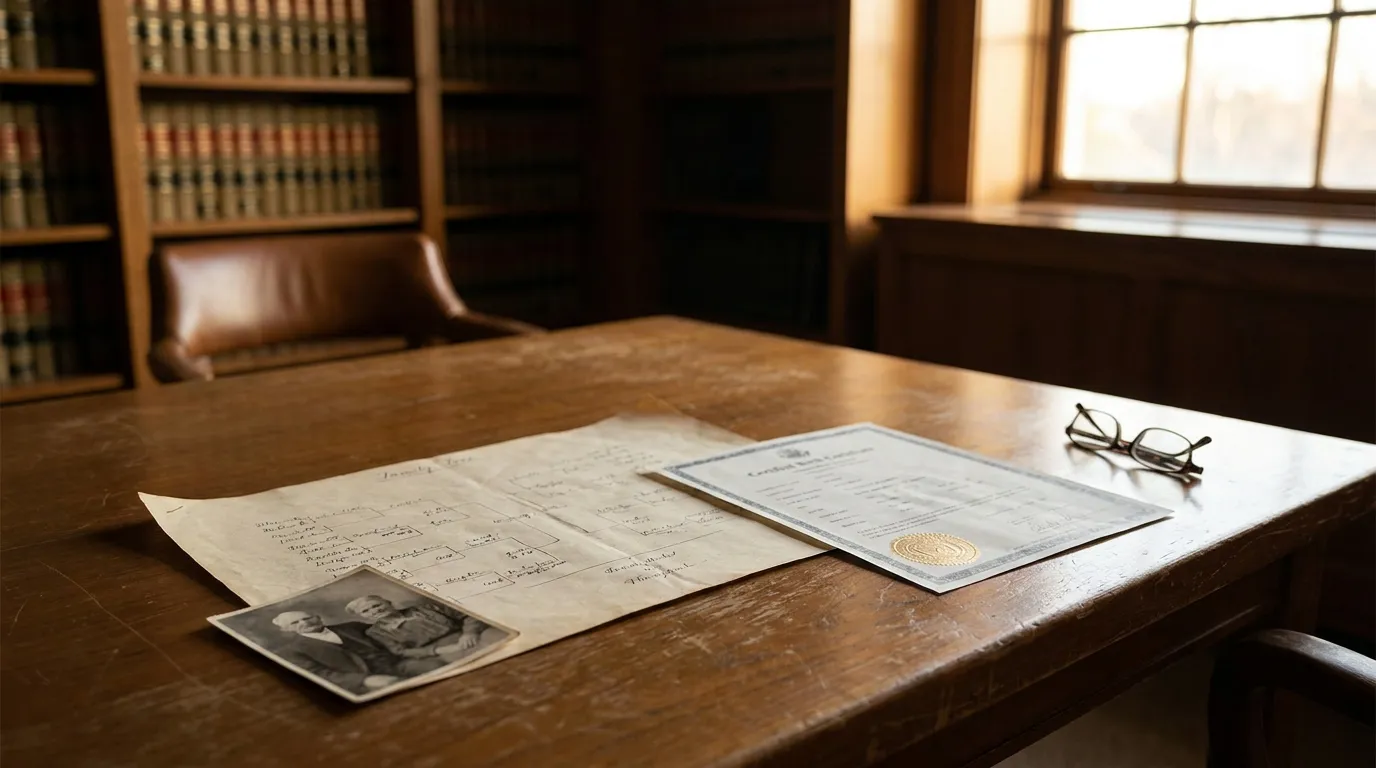
- Certified birth, marriage, and death certificates establishing each link in the family chain
- Immigration, census, military, church, and cemetery records where vital records are unavailable
- A family tree or genealogical chart prepared by a professional genealogist
- Testimony from disinterested witnesses with personal knowledge of family history
- DNA evidence, which courts may consider under certain circumstances
Published Surrogate’s Court decisions illustrate how these hearings may unfold. A 2025 Surrogate’s Court decision reported by the New York State Law Reporting Bureau reflects the kind of procedural detail, including referee findings and evidentiary analysis, that can shape outcomes. Because each ruling turns on its own record, no single trial-level decision controls elsewhere.
The Referee’s Report and the Court’s Decision
Many kinship trials are heard by a referee who then issues a report. Unless the parties have stipulated that the referee may determine the issues, the report is advisory, and the Surrogate may confirm, modify, or reject it. Parties generally have an opportunity to object, and the court’s ultimate decree controls who receives a distributive share.
Common Obstacles in a Brooklyn Kinship Hearing
Missing or foreign records often create the most frequent difficulty. Families with roots outside the United States often find that vital records were destroyed, never created, or exist only in another language requiring certified translation. Courts may accept secondary evidence, such as pedigree or family-history testimony, in limited circumstances, but generally evaluate such proof carefully.
💡 Pro Tip: Start gathering family documents before a hearing is scheduled. Obituaries, funeral home records, old passports, and family Bibles frequently supply the connecting detail that certified records lack.
How Kinship Proceedings Differ From Ordinary Probate
Probate involves a will; kinship proceedings typically arise in the absence of one. If you are handling an estate where a valid will exists, it helps to file for probate in New York with an understanding of the applicable steps. Kinship litigation, by contrast, generally focuses on family relationships and the intestacy hierarchy, though kinship questions can also arise in a probate matter when a will’s beneficiaries or the decedent’s distributees entitled to notice are unknown.
Related Proof-of-Heirship Mechanisms Under New York Law
Kinship hearings are not the only context in which New York may require formal proof of who the heirs are. Under Real Property Law § 321(5)(b), where no administrator has been appointed for a person dying intestate, the distributees may execute a certificate of discharge of a mortgage as if they were the personal representative, generally only after two years have elapsed since the date of death. That certificate generally must recite the decedent’s date of death, residence, the fact of intestacy, and that the signers constitute all of the distributees.
A parallel mechanism may exist when surplus or sale proceeds must be distributed to unknown heirs. Real Property Actions and Proceedings Law § 991 permits a special proceeding for the distribution of such proceeds, with notice served upon unknown heirs or their representatives, known heirs, their next of kin, and all persons interested in the proceeds. These provisions reinforce a consistent principle: heirship in New York is generally adjudicated, not presumed.
💡 Pro Tip: If you believe you may be a distributee of an estate already pending, ask whether a citation was issued to "unknown heirs." Responding promptly protects your right to participate.
Practical Steps for Families Facing an Estate Heirs Determination
Preparation often influences the outcome more than argument does. Because the burden of proving distributee status generally rests on the claimant, organized and authenticated documentation may carry substantial weight. Courts generally assess whether a diligent and exhaustive search has been made and whether the evidence reasonably excludes the possibility of nearer or additional heirs.
Consider these practical measures early in the process:
- Order certified copies of vital records rather than relying on photocopies
- Document every branch of the family, including deceased relatives and their descendants
- Preserve contact information for older relatives who can testify about family history
- Avoid distributing or spending estate funds before the court issues a determination
Experienced counsel can help frame the evidence in the form the court may expect. The attorneys at Goldberg Sager & Associates handle surrogate’s court heirship matters for Brooklyn and greater New York City families and understand how referees may evaluate genealogical proof. Outcomes remain fact-dependent, and no attorney can promise a particular result.
Frequently Asked Questions
1. How long does a New York kinship proceeding take?
Timing varies widely. Simple matters involving close relatives may resolve in months, while cases requiring international genealogical research can take considerably longer. Court calendars, witness availability, and record completeness all affect the schedule.
2. Who pays for the genealogist in a kinship trial under the SCPA?
Arrangements differ by case. Genealogists are sometimes retained by claimants and sometimes appear through other parties. Whether any part of the cost may be charged to the estate is generally a matter for the court in connection with the accounting, subject to applicable rules.
3. What happens if no heirs are ever proven?
Funds payable to unknown distributees are generally deposited with the State Comptroller, and the property may ultimately escheat to the State of New York. This generally occurs only after the court is satisfied that a diligent and exhaustive search for distributees has failed, and a later claimant may still apply for the funds within the periods allowed by law.
4. Can DNA testing establish distributee proof in New York?
Courts may consider DNA evidence under certain circumstances. It is rarely sufficient on its own and typically supplements documentary and testimonial proof. Admissibility and weight may depend on the quality of the sample, chain of custody, and the specific relationship at issue, and results may be less probative for more remote relationships.
5. Do I need to attend the hearing in person?
Attendance expectations depend on your role. A claimant whose testimony is required generally must appear, while represented parties may sometimes proceed through counsel. Your attorney can advise you based on the court’s directives in your particular matter.
Protecting Your Family’s Interest in an Intestate Estate
Kinship hearings exist because New York law generally insists that inheritance rights be proven rather than assumed. The Surrogate’s Court generally applies EPTL Article 4 to determine who qualifies as a distributee, and SCPA § 2225 and related provisions of Article 22 supply much of the procedural and evidentiary framework for that determination. Success generally depends on thorough documentation, credible testimony, and a clear demonstration that no nearer relatives exist. Every estate presents its own record, and results depend on the specific facts presented to the court.
If you believe you may be entitled to a share of a relative’s intestate estate, the team at Goldberg Sager & Associates is ready to review your circumstances and explain the path forward. Call 718-645-6677 or schedule a consultation today to protect your interest in a kinship hearing Surrogate’s Court New York proceeding.
Disclaimer: This content is for informational purposes only and is not legal advice. Every case is unique, and results may vary. Consult an attorney about your specific circumstances.