When a "Small" Sidewalk Crack Causes a Serious Injury
Key Takeaways: New York’s trivial defect doctrine is a defense, not an automatic bar to sidewalk fall claims, and no fixed measurement defeats a case on its own. Courts weigh width, depth, elevation differential, irregularity, and appearance alongside the time, place, and circumstances of the fall, so context often decides the outcome. In Brooklyn, an added procedural layer may apply: Administrative Code § 7-210 shifted most sidewalk liability to abutting property owners, with an exception for owner-occupied one-, two-, or three-family residences used exclusively for residential purposes, while claims against the City for City-owned property or certain tree-related conditions may face strict prior written notice rules. Responding to a triviality argument often depends on the record, including dated photos from multiple angles with a scale object, precise measurements, lighting and crowding documentation, witnesses, surveillance footage, and prompt medical records. Insurers frequently pair triviality with open-and-obvious, comparative fault, and notice defenses, so early preparation matters, and repairs or delay can quietly erode proof. Acting quickly to preserve evidence and consult counsel may help injured pedestrians present a stronger position, though every result depends on the specific facts.
If an insurer told you the sidewalk defect that broke your wrist was too minor to matter, that response has a name: the trivial defect defense. New York courts allow property owners and municipalities to argue that a walkway imperfection is so slight it cannot support a negligence claim as a matter of law. But New York’s highest court has made clear that no fixed measurement automatically defeats a case, and dimensions alone do not control the outcome. With the right evidence, some Brooklyn pedestrians may be able to push back.
Goldberg Sager & Associates has spent decades helping injured Brooklyn residents hold negligent property owners accountable. Call 718-645-6677 or contact us now for a free consultation, and learn more at Goldberg Sager & Associates.
What the Trivial Defect Doctrine Actually Says
The trivial defect doctrine is a defense, not a rule that automatically bars sidewalk fall claims. Under New York law, a landowner generally owes no duty to protect pedestrians against physically insignificant defects lacking the characteristics of a trap or nuisance. Whether a defect qualifies is generally a fact question, and courts have declined to adopt a bright-line measurement. The party moving for summary judgment generally bears the initial burden of showing the defect is trivial.
Instead of a ruler test, courts apply a multi-factor analysis examining width, depth, elevation differential, irregularity, and appearance, together with the time, place, and circumstances of the injury. A widely cited New York trial court decision on trivial defects shows how judges reject a purely mechanical approach and instead ask whether the condition presented a genuine hazard to an ordinary pedestrian.
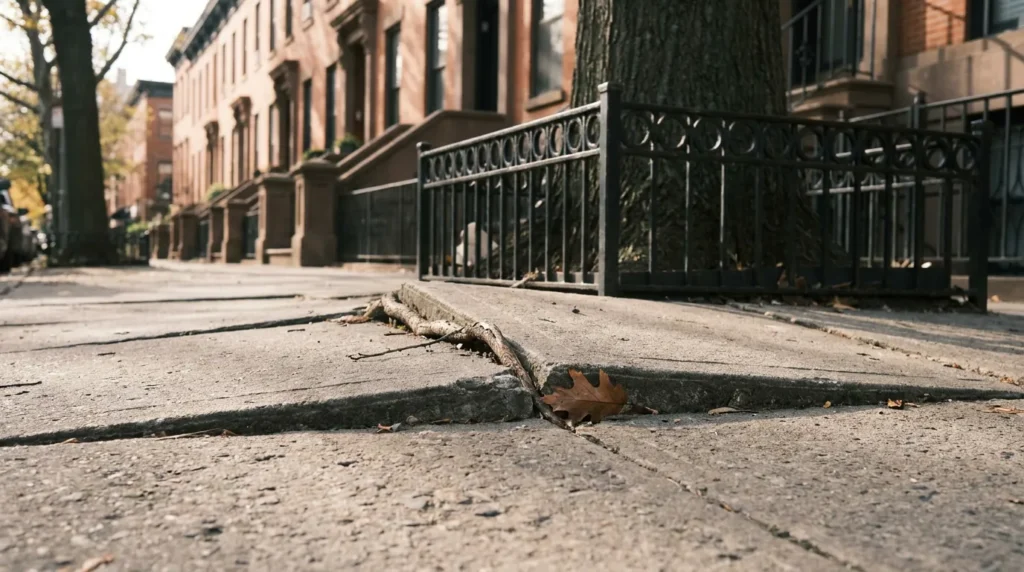
Context frequently matters. A half-inch lip in a well-lit, empty plaza may read differently than the same lip on a crowded Flatbush Avenue block at dusk, shadowed and surrounded by pedestrian traffic. Outcomes depend heavily on the specific facts.
Why Brooklyn Sidewalk Cases Have a Unique Procedural Layer
Before addressing triviality, you generally need to identify the correct defendant. New York City’s Administrative Code § 7-210 shifted sidewalk maintenance obligations and tort liability from the City to most abutting property owners, which may reshape who must answer for a broken flag or raised slab. Naming the wrong party can cost valuable time, and scholarly analysis in the Fordham Urban Law Journal traces how this liability transfer changed New York sidewalk injury litigation.
Exceptions still exist. The statute exempts owner-occupied one-, two-, or three-family residential properties used exclusively for residential purposes, so the City may remain responsible for those locations, as well as sidewalks abutting City-owned property. Claims involving City street tree roots are typically pursued against the City, subject to the notice rules below. Determining who bears responsibility often requires a title search, photographs, and sometimes a records request; see our guide on who is liable for NYC sidewalk injuries for a fuller overview.
Notice requirements may add another layer in claims against public entities. New York City and many municipalities operate under prior written notice laws, which generally bar suit over a defective, unsafe, or dangerous sidewalk unless written notice of that specific condition was given and not remedied within a reasonable time. Exceptions exist where the municipality affirmatively created the defect or where a special use conferred a benefit. These rules are typically construed strictly, vary by municipality, and are separate from both the notice of claim requirement and the statute of limitations.
How to Respond to the Trivial Defect Defense With Evidence
A trivial defect rebuttal often depends on the record you build. Defendants usually raise this argument through a summary judgment motion, and courts generally look for photographic and dimensional proof before deciding whether the defect had dangerous propensities. If the only evidence is a blurry cell phone photo taken months later, opposing summary judgment becomes far harder.
Evidence that may strengthen a sidewalk fall claim includes:
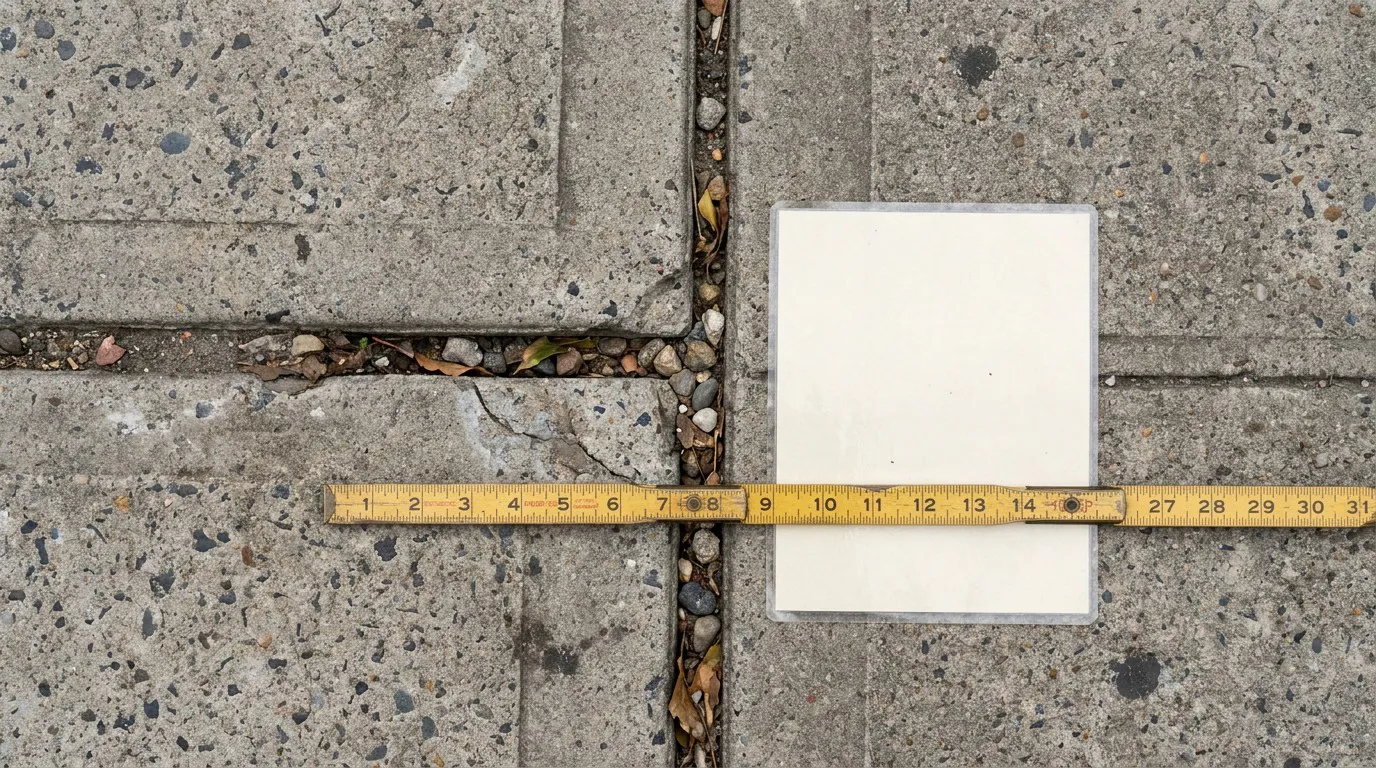
- Clear, dated photographs from multiple angles, with a coin or ruler for scale
- Precise measurements of width, depth, and vertical elevation differential
- Documentation of lighting conditions, shadows, and obstructions at the time of your fall
- Evidence of heavy pedestrian traffic or crowding that limited your ability to look down
- Witness names and contact information, plus nearby surveillance footage
- Prompt medical records connecting the fall to your diagnosed injuries
💡 Pro Tip: Photograph the defect during the same time of day and similar weather as your fall. Lighting and shadow evidence can matter as much as the tape measure.
Measurements Alone Rarely Win the Argument
Courts have generally declined to treat any particular height differential as automatically non-actionable. A quarter-inch edge with a jagged, chipped lip may be treated differently than a smooth, gradual one-inch slope. Irregularity, sharp edges, or a concealed depression may support the argument that the condition functioned as a trap.
Context Factors Carry Real Weight
Judges may consider where the fall happened and what a reasonable pedestrian could see. Defects near bus stops, subway stairs, storefront entrances, and busy corners may draw closer scrutiny because foot traffic can pull attention away from the pavement. Shade from scaffolding, sidewalk sheds, or parked delivery trucks can also conceal a hazard.
Timing Can Quietly Undermine a Strong Case
Sidewalks get repaired, and evidence disappears. Property owners sometimes fix a defect shortly after an incident, and because evidence of subsequent repairs is generally inadmissible to prove negligence, later documentation may do little to establish the original condition. Acting quickly to preserve documentation is one of the most practical steps an injured pedestrian can take.
Comparing How Courts Weigh Common Factors
| Factor Courts May Consider | Tends to Support the Defense | Tends to Support the Injured Pedestrian |
|---|---|---|
| Elevation differential | Small, gradual, uniform | Abrupt, jagged, or uneven edge |
| Lighting | Bright daylight, open area | Dusk, shadow, scaffolding, poor illumination |
| Location | Low-traffic, unobstructed path | Busy corner, transit stop, storefront entry |
| Appearance | Visible color contrast | Blends with surrounding pavement |
| Surrounding conditions | Clear, dry walkway | Debris, water, crowding, obstructed sightlines |
This chart reflects general tendencies in reported decisions and does not predict any particular result.
Applying the Trivial Defect Doctrine in New York to Your Own Case
Every trivial defect analysis begins with the specific facts of your fall. Courts repeatedly emphasize that each case must be examined on its own facts, which cuts both ways. That fact-sensitivity is why a well-documented file can, in some cases, turn what an insurer initially dismissed as a minor crack into a triable issue.
Appellate decisions continue to refine how the trivial defect doctrine in New York operates. Reviewing courts have reversed dismissals in some cases where plaintiffs submitted photographs, measurements, or testimony showing a defect carried trap-like characteristics despite modest dimensions. Conversely, where a defendant’s proof establishes that a defect is physically insignificant and lacks trap-like characteristics, courts have granted dismissal, underscoring how much the evidentiary record may shape the result.
A seasoned Brooklyn trip and fall attorney will also anticipate related defense tactics. Insurers commonly pair triviality arguments with claims of open and obvious conditions, comparative fault, or lack of notice. An open and obvious condition generally goes to comparative fault rather than eliminating a duty, and under New York’s pure comparative negligence rule, a plaintiff’s own fault reduces recovery but does not bar it. Preparing for the full premises defense challenge from the outset, rather than reacting after a motion is filed, may put injured pedestrians in a stronger position. Our team’s approach to these claims is outlined on our Brooklyn trip and fall attorney page.
💡 Pro Tip: Do not give a recorded statement estimating the defect’s size from memory. An inaccurate guess can later be used to support a triviality argument.
Frequently Asked Questions
1. Is there a minimum height difference that makes a sidewalk defect non-actionable in New York?
No. New York’s Court of Appeals has held that no fixed dimension automatically renders a defect trivial, and dimensions alone do not control. Courts generally evaluate the defect’s physical characteristics together with the surrounding circumstances.
2. What is the difference between a trivial defect argument and a lack of notice argument?
A trivial defect argument claims the condition was too minor to be actionable, so no duty arises. A notice argument claims the responsible party neither created the condition nor had actual or constructive notice of it in time to remedy it. Defendants frequently raise both, and each generally requires a different evidentiary response.
3. Can I still pursue a claim if the sidewalk was repaired before I took photos?
Possibly, though it may become more difficult. Investigators may locate prior images, municipal inspection records, business surveillance footage, or witnesses who observed the original condition. Outcomes depend heavily on what evidence can still be obtained.
4. Who is responsible for a broken sidewalk in front of a Brooklyn building?
In many instances, the abutting property owner may bear maintenance and liability responsibility under New York City’s Administrative Code § 7-210. Owner-occupied one-, two-, or three-family homes used exclusively for residential purposes are exempt, and the City generally remains responsible for sidewalks abutting City-owned property.
5. How quickly should I contact an attorney after a sidewalk fall?
As soon as reasonably possible. Negligence claims in New York are generally subject to a three-year statute of limitations, but claims against the City or other public entities typically require a notice of claim within 90 days of the incident and suit within one year and 90 days, deadlines that courts generally interpret narrowly.
Protecting Your Claim From a Premature Dismissal
The trivial defect doctrine in New York gives property owners and their insurers a genuine argument, but it is generally not an automatic defense. Because courts may weigh width, depth, elevation, irregularity, appearance, lighting, and pedestrian conditions together, detailed sidewalk defect evidence can play a significant role in whether a case survives summary judgment. Injured pedestrians who document the scene promptly, preserve witness information, and seek medical care without delay may place themselves in a better position, though every result depends on the individual facts and applicable law.
If a Brooklyn sidewalk fall left you injured and an insurer is calling the hazard insignificant, the team at Goldberg Sager & Associates is ready to review what happened. Call 718-645-6677 or schedule your free consultation today, and ask about home and hospital visits if your injuries make travel difficult.
Disclaimer: This content is for informational purposes only and is not legal advice. Every case is unique, and results may vary. Consult an attorney about your specific circumstances.